Featured Post

SHADE // Brother Isaiah (updated 2 August 2020)

From the CFR facebook page: "SHADE" is a new acoustic series featuring the music of Brother Isaiah, CFR. Brother Isaiah offers si...

Showing posts with label Bible Study. Show all posts

Tuesday, 7 April 2020

Peter's Denial, Palm Sunday 2020 // Music with Meaning // Third Day - Can't Take the Pain


There are a number of songs that Third Day have written from the point of view of a Gospel character. I have found this to be deeply nourishing encounters with the Word of God. They seem to me to embrace the Jesuit spirit of entering into the scenarios and embracing the emotions of the character you are drawn to. This particular song is written from the point of view of Peter after denying Christ three times.


Matthew 26:31-35 New Revised Standard Version Catholic Edition (NRSVCE)

Peter’s Denial Foretold

31 Then Jesus said to them, “You will all become deserters because of me this night; for it is written,
‘I will strike the shepherd,
    and the sheep of the flock will be scattered.’
32 But after I am raised up, I will go ahead of you to Galilee.” 33 Peter said to him, “Though all become deserters because of you, I will never desert you.” 34 Jesus said to him, “Truly I tell you, this very night, before the cock crows, you will deny me three times.” 35 Peter said to him, “Even though I must die with you, I will not deny you.” And so said all the disciples.

Matthew 26:69-75 New Revised Standard Version Catholic Edition (NRSVCE)

Peter’s Denial of Jesus

69 Now Peter was sitting outside in the courtyard. A servant-girl came to him and said, “You also were with Jesus the Galilean.” 70 But he denied it before all of them, saying, “I do not know what you are talking about.” 71 When he went out to the porch, another servant-girl saw him, and she said to the bystanders, “This man was with Jesus of Nazareth.”[a] 72 Again he denied it with an oath, “I do not know the man.” 73 After a little while the bystanders came up and said to Peter, “Certainly you are also one of them, for your accent betrays you.” 74 Then he began to curse, and he swore an oath, “I do not know the man!” At that moment the cock crowed. 75 Then Peter remembered what Jesus had said: “Before the cock crows, you will deny me three times.” And he went out and wept bitterly.

Footnotes:

  1. Matthew 26:71 Gk the Nazorean
New Revised Standard Version Catholic Edition (NRSVCE)
New Revised Standard Version Bible: Catholic Edition, copyright © 1989, 1993 the Division of Christian Education of the National Council of the Churches of Christ in the United States of America. Used by permission. All rights reserved.

Friday, 18 March 2011

Lent Reflection: The Temptations of Christ in the Desert (Part 4)

The Third Temptation

When scripture is quoted and the text is not provided, please look to the bottom of the reflection for the text of the scripture.

Let us once again look at the text from the Gospel according to Matthew.

Mat 4:1-11 

(1) The Holy Spirit led Jesus into the desert, so that the devil could test him. (2)  After Jesus had gone without eating for forty days and nights, he was very hungry. (3)  Then the devil came to him and said, "If you are God's Son, tell these stones to turn into bread.” (4)  Jesus answered, "The Scriptures say: 'No one can live only on food. People need every word that God has spoken.' " 

(5)  Next, the devil took Jesus to the holy city and had him stand on the highest part of the temple. (6)  The devil said, "If you are God's Son, jump off. The Scriptures say: 'God will give his angels orders about you. They will catch you in their arms, and you won't hurt your feet on the stones.' "  (7)  Jesus answered, "The Scriptures also say, 'Don't try to test the Lord your God!' " 

(8)  Finally, the devil took Jesus up on a very high mountain and showed him all the kingdoms on earth and their power. (9)  The devil said to him, "I will give all this to you, if you will bow down and worship me.” (10)  Jesus answered, "Go away Satan! The Scriptures say: 'Worship the Lord your God and serve only him.' "  (11)  Then the devil left Jesus, and angels came to help him.


The third temptation is the climax of this whole episode. When reading Holy Scripture we most always strive to keep the fullness of its Truth in mind. This is the only way to understand the truth.

In this temptation, Satan offers Christ all the physical power the world can offer. The catch is that Jesus must bow before the Devil. This is asking Jesus to forsake his mission, to give up God.

Is this not a small price to pay for such great influence? Could Jesus not, for just that moment, deny God? After all, if he had such worldly influence, then he would be able to convert the whole world to his message of Love. Seems like a very human response.

However, as we have seen from the other temptations, this view is totally incompatible with belief. It represents a belief in the world, not in God. It presupposes that the physical is more important than the spiritual. By its very nature, the decision to relegate God to come later is a rejection of God. This rejection precludes the ability to experience God. The mindset is incompatible with true belief.

The people are tempted in the same way later in the Gospels. This time the people must choose: Worldly power or God's Kingdom. We must look to the readings from Palm Sunday. At the trial of Jesus Christ, Pilate offers the crowd a choice between Jesus, called the Christ and Jesus Barabbas.

We need to delve deeper into this choice offered to the people. In the Gospel of Matthew, we read, “At that time a well-known terrorist named Jesus Barabbas was in jail. (Mat 27:16).” We know from the context of the term used to describe Barabbas (here translated as terrorist) that Barabbas had been involved in an uprising against the ruling Romans. He was a “freedom fighter”. The form of his name also suggests he was the ruler of the group of insurgents (we recall Bar-Kokhba who was head of the Jewish force in the last great Jewish messianic war in 132AD). Jesus Barabbas therefore presents a Messianic figure: A political Messiah. The type of Messiah the Jews were expecting. One who would bring physical power.

The name Barabbas can be broken down to Bar-Abbas. This translates as “son of the father”. Ring a bell? We see in this story the clear choice between a political messiah who promises worldly power and a messiah who offers only a message of Love. The two characters juxtapose each other in all respects, but both claim the messiahship. Moreover, the people, offered the same choice as Jesus was in the Third temptation, choose worldly power. This choice is the human decision. This decision does not look to the Kingdom of God. We know that they chose wrongly. Are we too going to choose the wrong Kingdom to pursue? Do we answer as Christ did, or do we side with the crowd screaming, “We want Barabbas?” we want this world’s power.

Which "Son of the Father" do you choose?

THE END

Post script:
I would just like to discuss the “Kingdom of God” as used in the Gospels. The word used for “Kingdom” is not a noun. It is a verb! The Hebrew word is malkut; it means the active lordship of the king. We can say then that the Kingdom of God does not lie after death, but exists on earth when we allow Gods will to rule our lives.

Wednesday, 16 March 2011

Lent Reflection: The Temptations of Christ in the Desert (Part 3)

The Second Temptation

When scripture is quoted and the text is not provided, please look to the bottom of the reflection for the text of the scripture.

Let us once again look at the text from the Gospel according to Matthew.

Mat 4:1-11 

(1) The Holy Spirit led Jesus into the desert, so that the devil could test him. (2)  After Jesus had gone without eating for forty days and nights, he was very hungry. (3)  Then the devil came to him and said, "If you are God's Son, tell these stones to turn into bread.” (4)  Jesus answered, "The Scriptures say: 'No one can live only on food. People need every word that God has spoken.' " 

(5)  Next, the devil took Jesus to the holy city and had him stand on the highest part of the temple. (6)  The devil said, "If you are God's Son, jump off. The Scriptures say: 'God will give his angels orders about you. They will catch you in their arms, and you won't hurt your feet on the stones.' "  (7)  Jesus answered, "The Scriptures also say, 'Don't try to test the Lord your God!' " 

(8)  Finally, the devil took Jesus up on a very high mountain and showed him all the kingdoms on earth and their power. (9)  The devil said to him, "I will give all this to you, if you will bow down and worship me.” (10)  Jesus answered, "Go away Satan! The Scriptures say: 'Worship the Lord your God and serve only him.' "  (11)  Then the devil left Jesus, and angels came to help him.


This second temptation is an interesting one. It also is a difficult one to understand. We see that the Devil himself is a Scripture Scholar! In essence, this theological debate between Jesus and the Devil is a debate concerning the image of God. “Who is God?” is the issue.

To provide a defence against the first temptation, Christ quoted Scripture. Seizing on the opportunity presented, Satan attempts to twist the Bible to his own ends. He quotes Psalm 91:11-12 verbatim. Jesus responds with a quote from Deuteronomy 6:16. Against this background, we can begin to examine the debate.

Satan takes Jesus to the highest point of the Temple. This was the place where people would find God. He then tries to prompt Jesus into forcing God to prove He exists. He wants Jesus to put God to the test. This is why Jesus responds as he does. The quote from Deuteronomy is in response to the story in Exodus 17. The people where beginning to doubt that the Lord was with them. They wanted some miracle, some proof. Jesus recognises these intentions and refuses to allow Satan to fool him.

Let us stop for a moment. What is actually wrong with asking God for a little bit of proof. If we could prove in a scientific way that God existed, I am sure it would be a great help for each of us. Nevertheless, there is a fundamental problem here. Trying to subject God to testing in this way is arrogance. An arrogance that is incapable of perceiving God. When we try imposing out test conditions on Him, we place ourselves above him and then look for physical proof. It forces us to ignore the whole dimension of love. Modern man only believes that which he can test and grasp. This lack of openness to love and interior listening closes the way to God. It is impossible to find God by searching in this way.

We cannot ask God to prove He is God. We then put ourselves above him, and in doing so make ourselves God. We put ourselves in the position of judging the truth from lies. Satan in his use of Scripture is playing on this theme. He is attempting to put himself in God’s place. Once there he will decide the truth. Satan uses his quote as a stand-alone reference. In this way, he is assuming that God really has nothing to say to us in the Bible as a whole. He relegates the Bible to a tool for supporting any deed.

Jesus on the other hand provides a better model. He refuses to put God to the test. He knows that to do so would already exclude the openness to accept the proof. He is able to put the Psalm into a broader context. He knows that the quote provided by Satan does not refer to earthly comfort and protection. It is about a much deeper comfort, the confidence that he will receive comfort in eternity.

We see that the debate is about how we can and cannot know God. If we decide to try proving God’s existence, we already put ourselves in a position where this becomes impossible. How can you prove Love? However, if we accept the Love of God, then we will know God.


Bible verses forming part of the discussion, but not quoted above:

(Psalm 91:11-12)
God will command his angels to protect you wherever you go. They will carry you in their arms, and you won't hurt your feet on the stones.

(Deut 6:16)
…don't try to make him prove that he can help you, as you did at Massah.

(Ex. 17:1-7)
The Israelites left the desert and moved from one place to another each time the LORD ordered them to. Once they camped at Rephidim, but there was no water for them to drink. The people started complaining to Moses, "Give us some water!" Moses replied, "Why are you complaining to me and trying to put the LORD to the test?" But the people were thirsty and kept on complaining, "Moses, did you bring us out of Egypt just to let us and our families and our animals die of thirst?" Then Moses prayed to the LORD, "What am I going to do with these people? They are about to stone me to death!" The LORD answered, "Take some of the leaders with you and go ahead of the rest of the people. Also take along the walking stick you used to strike the Nile River, and when you get to the rock at Mount Sinai, I will be there with you. Strike the rock with the stick, and water will pour out for the people to drink." Moses did this while the leaders watched. The people had complained and tested the LORD by asking, "Is the LORD really with us?" So Moses named that place Massah, which means "testing" and Meribah, which means "complaining."

Sunday, 13 March 2011

Lent Reflection: The Temptations of Christ in the Desert (Part 2)

The First Temptation

When scripture is quoted and the text is not provided, please look to the bottom of the reflection for the text of the scripture.

Let us once again look at the text from the Gospel according to Matthew.
Mat 4:1-11  
(1) The Holy Spirit led Jesus into the desert, so that the devil could test him. (2)  After Jesus had gone without eating for forty days and nights, he was very hungry. (3)  Then the devil came to him and said, "If you are God's Son, tell these stones to turn into bread.” (4)  Jesus answered, "The Scriptures say: 'No one can live only on food. People need every word that God has spoken.' "  (5)  Next, the devil took Jesus to the holy city and had him stand on the highest part of the temple. (6)  The devil said, "If you are God's Son, jump off. The Scriptures say: 'God will give his angels orders about you. They will catch you in their arms, and you won't hurt your feet on the stones.' "  (7)  Jesus answered, "The Scriptures also say, 'Don't try to test the Lord your God!' "  (8)  Finally, the devil took Jesus up on a very high mountain and showed him all the kingdoms on earth and their power. (9)  The devil said to him, "I will give all this to you, if you will bow down and worship me.” (10)  Jesus answered, "Go away Satan! The Scriptures say: 'Worship the Lord your God and serve only him.' "  (11)  Then the devil left Jesus, and angels came to help him.
In the first temptation Satan waits for Christ to be at a very weak point before confronting him with a temptation. After some time without eating, Lucifer’s proposition is to give Jesus some comfort by way of food. We see how cunning the Devil is, he doesn’t appear to be doing any harm, just giving a suggestion which would bring comfort. Doesn’t this seem familiar? A temptation presented as an opportunity to help, to comfort?

But Jesus responds, sensing the evil intentions of the Evil One. Jesus knows that the soul is much more important than bodily health. This gives us the real meaning of “Fear of the Lord”: it is being more afraid of damaging your soul than of losing some physical ability, or foregoing some pleasure. Jesus is being asked here to choose his bodily existence over his eternal one. He is actually being asked to prove that he is the Son of God. We that Jesus understood the undertones of the temptation by his response: “No one can live only on food. People need every word that God has spoken.” This is a quotation of Deuteronomy 8:3: “so he made you go hungry. Then he gave you manna, a kind of food that you and your ancestors had never even heard about. The LORD was teaching you that people need more than food to live--they need every word that the LORD has spoken.” We can further assert that, as we hear in St John’s Gospel, Jesus is the Word and that it is Jesus we need to survive into eternity. We have Jesus when we live by his example, by obeying his teaching, by living lives full of Love.

In this short Gospel passage we see Christ giving us the right order of being. First comes God (who is Love (1 John 4:8)), then everything else to follow. So often in our lives we are tempted to first try provide for a comfortable life and then we think we can see to our souls when we are comfortable. Jesus teaches us here that we will never really be comfortable until we put Love first, the ultimate Love, the Love revealed by Christ, who is God who is Love.

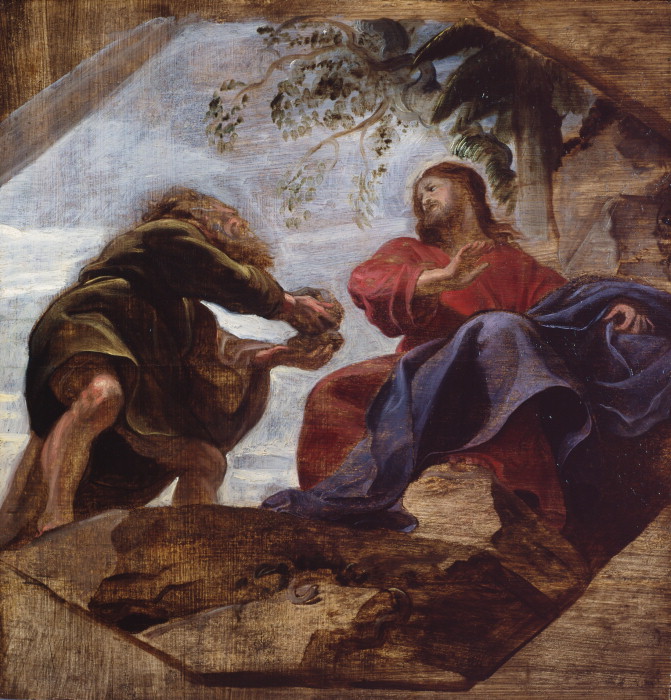
The temptation is often also to try and provide “bread” to others. Isn’t world hunger the saddest thing, which proves that a loving God does not exist? Shouldn’t the Messiah be able to provide bread? No doubt, there are so many people in need. But when we don’t respect the right ordering, and put bread above Love, then we will fail those we are trying to help. We will end up giving stones and not bread. Below we see that Jesus does give bread to the people in a different setting. One that occurs in the correct context: where the giving of bread is in the correct context, not to prove his power only.

We are continually asked to remember this right ordering of things, so that we may always be able to provide real bread. Now, you may ask, where have we seen that bread is provided; all we’ve seen here is hunger. Let us go further on in the Gospel, to an event where Jesus does provide bread. I would like to quote directly our dear Pope B16 who talks of the miracle of the multiplication of the loaves to feed the thousands (see: Mt 15:34 – 38):
“Why does Christ now do the very thing he had rejected as a temptation before? The crowds had left everything in order to come and hear God’s word. They are people who have opened their heart to God and to one another; they are therefore ready to receive the bread with the proper disposition. The miracle of the loaves has three aspects, then. It is preceded by the search for God, for his word, for the teaching that sets the whole of life on the right path. Furthermore, God is asked to supply the bread. Finally, readiness to share with one another is an essential element of the miracle. Listening to God becomes living with God, and leads from faith to love, to the discovery of the other. Jesus is not indifferent toward men’s hunger, their bodily needs, but he places these things in the proper context and the proper order.” (Jesus of Nazareth, Pope Benedict XVI, 2007, p32)


Bible verses mentioned above, not quoted:
(Mat 15:34-38)
Jesus asked them how much food they had. They replied, "Seven small loaves of bread and a few little fish." After Jesus had told the people to sit down, he took the seven loaves of bread and the fish and gave thanks. He then broke them and handed them to his disciples, who passed them around to the crowds. Everyone ate all they wanted, and the leftovers filled seven large baskets. There were four thousand men who ate, not counting the women and children.


Thursday, 10 March 2011

Lent Reflection: Temptations of Christ in the Desert (Part 1)

Introduction

When scripture is quoted and the text is not provided, please look to the bottom of the reflection for the text of the scripture.

Let us start by looking at the text from the Gospel according to Matthew.

Mat 4:1-11 

(1) The Holy Spirit led Jesus into the desert, so that the devil could test him. (2)  After Jesus had gone without eating for forty days and nights, he was very hungry. (3)  Then the devil came to him and said, "If you are God's Son, tell these stones to turn into bread.” (4)  Jesus answered, "The Scriptures say: 'No one can live only on food. People need every word that God has spoken.' " 

(5)  Next, the devil took Jesus to the holy city and had him stand on the highest part of the temple. (6)  The devil said, "If you are God's Son, jump off. The Scriptures say: 'God will give his angels orders about you. They will catch you in their arms, and you won't hurt your feet on the stones.' "  (7)  Jesus answered, "The Scriptures also say, 'Don't try to test the Lord your God!' " 

(8)  Finally, the devil took Jesus up on a very high mountain and showed him all the kingdoms on earth and their power. (9)  The devil said to him, "I will give all this to you, if you will bow down and worship me.” (10)  Jesus answered, "Go away Satan! The Scriptures say: 'Worship the Lord your God and serve only him.' "  (11)  Then the devil left Jesus, and angels came to help him.


For this time I’d like to focus on the first two verses.

Now, at first read, it does seem strange that the Holy Spirit would lead Jesus into the desert so that he could be tested, and not just tested, but tested by Satan. Should it really surprise us though? I mean, how would Jesus, being fully human, really, really know who he was if he didn’t face a challenge? Our beliefs are shaped not only by intellectual arguments, but also more strongly by experience. If Jesus did not experience the temptations, and emerge triumphant, would he know what he believed? Having faced the temptations that Satan put to him, and emerged victorious, he was able to concretely testify to what his mission was. He was able to define, for both himself, and us what he came for. You need to be confronted by an idea to form an opinion.

We must also understand that for Jesus to find and save the lost sheep, he must enter the place where it has been lost. He must totally follow down the path that leads to such a loss of self, and in order for redemption to occur, he must conquer the things that cause man to lose himself. However, if Jesus where to give into these temptations, it would not be possible for him to redeem us. In addition, if he did not face the temptations then Jesus would not be able to redeem us, because he would have no contact with us, no opportunity to truly find us (See Heb 2:18). Often we hear the expression, “Don’t judge unless you’ve walked a mile in their shoes.” This is true. Perhaps we can extend this and say, “Don’t try and help unless you can see the person’s shoes.” In this way, many charitable actions would be saved from failure. Sending money to a foreign place is not much help to the people. What they need is recognition. For someone to get close enough to understand the problems. When you send money from afar, you cannot have any idea of whether the project addresses the needs. The philanthropist must immerse himself in the problems, in the pain, of the one he seeks to help. Only in that way can he know what to do.

Back to the Gospel, what I am trying to say is this: Jesus was led by the Spirit to the place where he could find fallen humanity and from there begin to guide us home. He felt our pain, experienced our problems. He knows what we need. And not only did he walk a mile in our shoes, I’m sure in 40 days he covered more ground than that.

Also, notice that Jesus fasted for 40 days and nights in the desert before he was tempted. A period we try to emulate during lent (except that we have some respite each Sunday). This is very important because it was an opportunity for Jesus to learn in the School of Silence. In the School of Silence a person is left to find only himself or herself, their core identity, and in this core identity we recognise our relationship with God. But if the noise of the world is never escaped we can never discover the boundless beauty of this relationship. And if we don’t recognise Jesus, who is also God, when he comes to save us by pointing the way home, how will we ever find the way out of our “lostness”? Jesus built strength in the School of Silence and knew His Divinity (knowledge hidden from the devil), with this knowledge He was ready to refuse anything the devil could offer him. If we, too, are able to move away from the noise of the world we will also discover our relationship with Jesus and be able to know what we are created to be. A discovery so precious, the pearl of great price (Mat 13:46) if you will, that nothing can remove God's peace from us.

Let’s look at the 40 days part. Now, honestly, no matter how bad the food available is, nobody can go without it for 40 days and nights. Impossible. So what is this trying to tell us? The early Church Fathers stretched numerology a bit and said that the four represents the world (North, South, East, West being four corners of the world) and the 10 to represent the 10 commandments, or the law. Hence, 40 represents the law expanded to embrace all nations. And this is consistent with Jesus’ teaching. Another way to view this number is to see in it the reflection of the events in salvation history: Noah’s Ark (rain for 40 days and nights), the 10 commandments (Moses went up Mount Sinai for 40 days), and the Exodus (40 years in the desert). In this, we see Jesus connecting himself, identifying himself, with salvation history. 

As a closing for this introduction, I’d like to point out a link to the Old Testament. Where Adam was tempted in the garden he succumbed, as has humanity since. When Jesus was tempted in a place that would become the place of reconciliation and healing, the antidote to the sin, its opposite side, just as the desert is the opposite of the garden. And the antidote to our fallen condition is Love. Jesus teaches always how to love. From the above I think we can see that this love is one of compassion, of entering into the others suffering. The world needs this love. That Christians enter into each other’s “passion” if you will. That we have com-passion. Let’s use the time of lent to feel compassion for those who are less fortunate, and then let’s do something for them.


Scripture verses:

Heb 2:18  And now that Jesus has suffered and was tempted, he can help anyone else who is tempted.

Mat 13:46  and having found one pearl of great price, he went and sold all that he had, and bought it.

Saturday, 22 January 2011

Music with Meaning - Satan Your Kingdom Must Come Down - Robert Plant


This a beautiful old gospel song. Robert Plant has done an amazing job on this cover version from his latest album "Band of Joy." I am in love with this dirge, simple but powerful. As the pope says in "Light of the World" - "Simplicity is Truth - and Truth is simple."

The picture shown above is of St Michael the Archangel defeating Satan.
We can pray to St Michael:
St Michael, Archangel
Defend us in battle
Be our protection against the wickedness and snares of the devil
May God rebuke him,
we humbly pray,
and do thou,
Oh prince of the heavenly host,
thrust into hell
Satan and all evil spirits who prowl through the world for the ruin of souls.

These days many people are confused about the idea of hell. "How can a forgiving God send anyone to eternal suffering?" they ask. But let us flip that around. Remember that it is not God who condemns to Hell, but people who themselves turn their back on God and deprive themselves of his presence. When we look back at the story of the first sin in the Garden of Eden we read: 
"And they heard the voice of the LORD God walking in the garden in the cool of the day: and Adam and his wife hid themselves from the presence of the LORD God amongst the trees of the garden." 
(Genesis 3:8)
They knew they had been disobedient and felt ashamed, but God still wished to be with them. However, they hid. They had wanted to be "as gods, knowing good and evil" (Gen 3:5b). And in an attempt at making themselves into gods they gave up the innocent beauty that was entrusted to them.
We too, continue in our pride to try and decide what is good and what is evil. It is only when we turn back to God and trust His goodness, when we give up wanting to justify ourselves that we can let ourselves look upon him in trust and joy. We cannot love God and impose our ideas on Him.
Hell is our choice to turn our backs on God. To be close to Him in the next life, but not allow ourselves to receive his loving embrace. God always calls us into His embrace, it is we who hide.


Sunday, 12 December 2010

Message for third week of Advent from sunny South Africa

I arrived back in Vereeniging yesterday and had a wonderful Mass in Our Lady of Perpetual Help parish Church this morning. I'd like to share the reflection printed on the Catholic Link leaflet produced by Redemptorist Pastoral Publications.

"Prepare"
Advent is a time of careful preparation as we welcome God in the person of Jesus Christ. Metaphors of preparation include - building a bridge; preparing the soil; laying the groundwork. The model of preparation that I propose is based loosely on the spiritual preparation we make in uniting ourselves with Jesus in Holy Communion.
Firstly, we make an act of faith in the goodness of the divine initiative of God. God always takes the first step in coming towards us. Although we deserve punishment for our sinfulness, God does not approach us as a vindictive judge but as a divine physician - to heal us from the wounds of sin. Our act of faith possesses our hearts with eagerness as we welcome the God of mercy and compassion. Our eagerness is characterised by an absence of fear since God who is love, dispels all fear.
Secondly, we make an act of contrition. The familiar act of contrition posits that we are sorry for having sinned against God because He is so good. This is the proper motive for contrition. Other motives such as fear of punishment or eternal separation are not invalid, but they do not reflect accurately the love of God which inspires our contrite hearts. The communion that God desires to have with us is a communion of love. A handy way of assessing our contrition is to look at the ways in which we have disobeyed the commandments of God. Do I love God with all my heart and soul? Have I shown love and respect to the most important people in my life? Do I live with my neighbour in peace and truth? Do I respect the beauty of sexuality as a gift for the building up of the family? Like the psalmist, we desire to climb the mountain of the Lord and stand in his holy presence.
God accepts our act of contrition and purifies our hearts and our hands that we might receive him worthily.
Thirdly, we make an act of love. In order to receive Love into my heart, I resolve to act in love. We listen to and act upon the words of the Baptist. The signs of conversion must be seen in actions which manifest our decision to turn to the Lord. We acknowledge that it is useless to profess our love for God if we do not love our neighbour. We share our food, our clothing, our time and talents. When we exercise charity towards our neighbour, we are ministering to Christ himself. This is a cause of great joy for us. When we recognise that it is Christ to whom we are ministering, we understand that the poor, the hungry and the suffering are not objects of our pity but rather are instruments effecting our own evangelisation.
Through faith we prepare the soil of our hearts to receive God. By contrition we build a bridge for God. In love we lay the foundation for God's kingdom to be established.

Thursday, 4 November 2010

Atheists have souls too! A view on atheism from 1880

Here is something from The Karamazov Brothers by Fyodor Dostoevsky written in 1880. Just shows you that Truth is unchanging (emphasis added):
'Remember, young man, unceasingly,' Father Paissy began, without preface, 'that the science of this world, which has become a great power, has, especially in the last century, analysed everything divine handed down to us in the holy books. After this cruel analysis the learned of this world have nothing left of all that was sacred of old. But they have only analysed the parts and overlooked the whole, and indeed their blindness is marvelous. Yet the whole still stands steadfast before their eyes, and the gates of hell shall not prevail against it. Has it not lasted nineteen centuries, is it not still a living, a moving power in the individual soul and in the masses of people? It is still as strong and living even in the souls of atheists, who have destroyed everything! For even those who have renounced Christianity and attack it, in their inmost being still follow the Christian ideal, for hitherto neither their subtlety nor the ardour of their hearts has been able to create a higher ideal of man and virtue than the ideal given by Christ of old. When it was attempted, the result has been only grotesque...
(from Chapter 1 of Book four in Part 2 of The Karamazov Brothers)

Let's read this in conjunction with Jesus' own teaching:
Jesus answered, "If you were blind, you would not be guilty. But now that you claim to see, you will keep on being guilty."  (John 9:41 CEV)
Let us take a step back in humility and defer to God's timeless Truth in those moments when we can't see the whole picture. And let us especially not force our skewed views onto others in pride. May Jesus take away our blindness each day.

Tuesday, 26 October 2010

Word of God - 2010-10-26


Whomever labors as he prays
lifts his heart to God with his hands.
(St. Benedict, 6th century) 


Subscribe at WordofGodEveryday.com

Wednesday, 20 October 2010

Whose your daddy?

Once again I would  like to share something from Papa Ratzi. This time from Jesus of Nazareth. Remember when Pontius Pilate offered to release one of Jesus Christ or Barabbas? Until the third century many copies of the gospels called Barabbas by the name of Jesus Barabbas. When we break down the name we see Bar-Abbas, Bar meaning son, Abba meaning father (daddy really). Hence we have Jesus the Christ put against Jesus the son of the Father, reflecting two messianic figures for the Jewish people, and they come together in the scene as alter egos. Barabbas was probably a mercenary who was leading revolts against the Roman governors. So we have Jesus Christ who is represents a fight for a kingdom of Love, not of this world, and Jesus Barabbas who is fighting for worldly power. And we know that the people who called for Barabbas to be released show that they choose worldly power over God's message. We still do that today. And so a story we pass over so quickly every year becomes a little bit deeper.
Jesus of Nazareth 

Friday, 8 October 2010

Why do Catholics pray through Mary? Because they are Jewish of course...

This is something I learned today as I was reading the first pages of Taylor Marshall's book "The Crucified Rabbi" as he explains how a Rabbi began his journey from Episcopalean pastor to Catholic Priest. On his first assignment he was asked to do a hospital visitation. He got his prayer book ready, along with his stole and went to the hospital, only to find the patient he was to pray for was Jewish (her husband was Episcopalian and she attended the services with him). As Fr Taylor was leaving the hospital room he bumped into her Rabbi who had also come to pray with her. The Rabbi asked the husband for the name of his wife's mother (as the patient had fallen asleep and could not be asked). The husband was perplexed and asked Rabbi why he needed that info and the Rabbi replied: "We Jews believe that if someone is suffering and you invoke the name of his or her mother in prayer, God will be more merciful in granting your prayer for that person."
This series of events began Fr Taylor's discovering the Biblical roots of Catholicism and his conversion.
I researched a bit further on this topic and found that it is rooted in Psalm 116 which reads "I worship you, LORD, just as my mother did, and you have rescued me from the chains of death."  (Psa 116:16 CEV). We must also note that the Jewish faith is passed down from the mother and when praying for someone they would emphasize their eternal link to God which comes from the mother.
As Catholics we pray for Mary's intercession as our mother, the mother of all of us in Faith. We can say, even, that Mary is the new Abraham, but whereas Abraham was spared the sacrifice of his son Isaac, Mary was entrusted to see her son sacrificed for our salvation. She is, so to say, Abraham going even one step further. She, like Abraham, watched her only son carry the wood for his own sacrifice up the hill. However, she was not spared the sacrifice of her son. Truly, just as Abraham is our father in Faith, so Mary is our Mother, believing that God's plan brings salvation in any circumstances.
We also know that Mary is our mother from the word's spoken to John from the Cross: "Behold your mother" (Jn 19:27).
Let us thank Jesus for given His blessed Mother to us and pray continually for her intercession, remembering that it was at the prompting of Mary that Jesus performed His first public miracle at the wedding feast at Cana (John Chapter 2).
Hail Mary, full of grace, the Lord is with thee, blessed are thou among women and blessed is the fruit of thy womb, Jesus. Holy Mary, mother of God, pray for us sinners, now and at the hour of our death.

Saturday, 2 October 2010

Short reflection on the Joyful Mysteries

I would like to share with you my reflections for the joyful mysteries today. I actually wrote these down at the beginning of 2008 when I was living in Sudan. Here goes:

We learn to accept what is asked of us (the annunciation). We are also called to visit our friends frequently to share in their joy and to bring them our good news (as Mary shows in the Visitation), and when others visit us, even if it inconveniences us, we should welcome them graciously (as Mary and Joseph welcomed the shepherds and wise men to the stable in which Christ was born), and when we are visited by anyone, no matter how humble or insignificant they appear we should be able to recognise God in them (as Simeon recognised the Messiah in the baby Jesus, even though he would have scarcely believed that he could be saved by an infant). Lastly, when ever we visit or entertain friends, it is key to listen to them and question them in such a way as to open them to God's message of Love, never criticising nor condoning mistakes or prejudices, but guiding them (as Jesus did when in the Temple as a 12 year old young boy).
God Bless

Wednesday, 29 September 2010

LISTEN (a Biblical meditation)

In 2007 I attended a retreat day with some religious brothers from the Taize community in France. The community is an ecumenical Christian community who witness to the faith. Each year around 100,000 young people go to Taize. The brothers mostly just listen to the young people. Many of you will also be familiar with the popular Taize songs. These are simple, repetitive chants which are very meditative. These songs also encourage a deep meditation and listening to God.

I would like to share with you the importance of listening to God as shared by one of the brothers. This is done through reference to various passages of Scripture.

The first passage is know as Shema Yisrael. This is the centrepiece of Jewish morning and evening prayer services. This prayer is found in the book of Deuteronomy 6:4 “Listen, Israel: The LORD is our God. The LORD is the only God.” As we can see, the first word is “Listen.” This is the beginning and end of prayer - to be open to listening attentively.

This is  again highlighted in the story of God calling out to Samuel. Samuel is asleep and hears a voice calling in the night. Samuel assumes it is Eli calling him and he runs to wake up Eli and ask him what he wants. Eli tells him that he did not call him and instructs Samuel to return to sleep. This happens a second and a third time. On the third occasion Eli realises that it is God calling Samuel (who was sleeping in the room containing the Ark of the Covenant) and instructs him as follows- “Go lie down," Eli told Samuel. "When he calls you, say, 'Speak, LORD. I'm listening.'" (1Sam 3:9).
Samuel does as instructed and the Lord instructs him.

We now see the same theme appearing in the New Testament. At the baptism of Jesus: A voice came out of the cloud and said, "This is my Son, whom I have chosen. Listen to him!" (Luke 9:35)

And when one of the scribes ask Jesus which is the most important commandment what is the first word Jesus says?
“Jesus answered, "The most important is, 'Listen, Israel, the Lord our God is the only Lord. “ (Mar 12:29). Listen.

Sometimes when we pray we are so busy listing our petitions that we don’t wait for the answer. We don’t join with Samuel in saying “Speak Lord, Your servant is listening.” We need to spend time in the School of Silence in the presence of the Lord and listen to wait he moves our hearts towards. Let us pray that we can find the time, courage, and patience to do so.

“Be still, and know that I am God” (Psalm 46:10)

Most popular